El Niño and the Coming Winter
Published at 21:17 on 2 September 2026
There is a lot of chatter about how we are in for a drought next year because we are in for an El Niño winter this year.
This is not necessarily so. In fact, it is not very likely in my view.
The strong correlation between El Niño and winter in this climate is with temperature, not precipitation: El Niño winters tend to be milder than average. So it is safe to bet that we are in for a milder than normal winter.
The correlation between El Niño and winter precipitation in this climate is not nearly so strong. Yes, our worst drought winters tend to be El Niño winters. No disagreement there. But that is the reverse of the correlation of interest: the correlation between A and B is not necessarily identical to the correlation between B and A.
In particular, the strongest El Niño events tend to be correlated with mild, wet winters in this region, not mild, dry ones. And the current El Niño is forecast to be exceptionally strong. Those drought winters? They tend to be correlated with normal to weak El Niño events, not the strongest ones.
Don’t take my word for it, here are the NOAA National Climate Data Center maps of temperature and precipitation anomalies of moderate-to-strong El Niño winters:
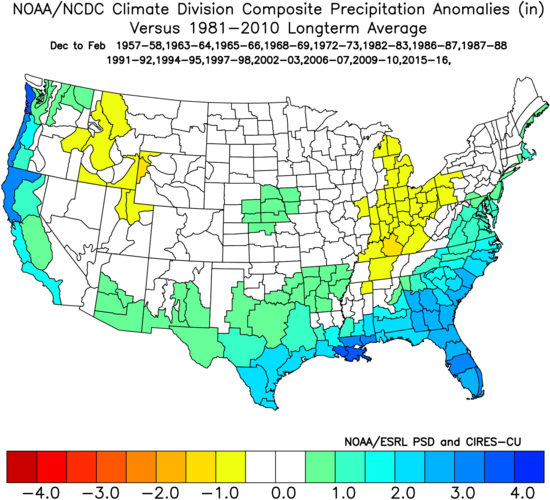
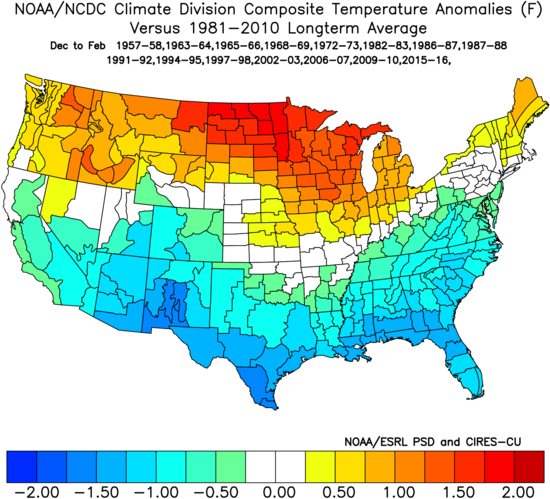
Source here.
It is likely that these milder than average conditions will result in higher than average snow levels, and thus a subpar ski season and a subpar snowpack in general. But that is a different thing from drought-level subpar snowpack. Other strong El Niño winters have generally not been drought winters, therefore I do not expect the coming winter to be one.
Finally, this does not mean no cold, snowy spells this winter.
First, the correlation between El Niño and winter conditions tends to be strongest in the latter part of the winter, after approximately New Year’s Day. It is not unusual for an El Niño winter to start with some early cold snaps.
Second, the correlation is between El Niño and milder average temperatures. It is entirely possible for there to be outlier events contrary to the general trend that determines an average; an overall warmer-than-average season can easily still feature a brief cold, snowy spell or two.
Third, our winters usually feature at least one cold, snowy spell in the lowlands. Snow-free, or nearly snow-free, winters like the past one are decidedly unusual. Even our mild winters usually feature at least some lowland snow.
So, to sum it up: Expect a milder-than-normal winter, but also expect some lowland snow. Do not expect a good ski season, but also do not expect a drought winter.