Questions about FlyDubai Flight 1073

Published at 18:33 on 30 September 2026

The story is that passengers and crew foiled an attempt by a rogue copilot to crash the aircraft, by breaking into the cockpit, subduing the copilot, and resuming control of the plane (one of the passengers being a pilot). Netanyahu has already proclaimed it a foiled terrorist attack amid celebrations at Ben-Gurion Airport.

Some things about this story just seem strange to me right off the bat. Specifically, two big things.

Breaking into the Cockpit

Simply put, this should not have been possible. After the 9/11 attacks, new standards for hardened cockpit doors were developed. There has now been a quarter century in which to fully implement those standards. Said standards should have, perversely, acted to make an incident like this, a security breach from inside the cockpit itself, harder to foil. Yet somehow, they did not. Why? Was the door not properly locked (if so, why)? Was the door defective (if so, why was the plane allowed to fly)? Did the pilot unlock it as part of the struggle for control (the stories I have seen do not mention this)? Did some passengers have tools with which to force the doors (if so, why were they allowed to board with such tools)? And so on.

Resuming Control of the Plane

It was incredibly convenient that there was a pilot qualified to fly a passenger jet flying as a passenger on that flight. Maybe there is nothing amiss here. Pilots book seats on passenger jets all the time. In fact, they are more likely to do so than normal people, because as airline employees they are typically entitled to fly for free or at a significant discount. But again, it strikes me as, shall we say, curiously convenient.

Remember Who Is Celebrating

Namely, the Netanyahu regime, which is best described as a rogue regime. Because it is: it flouts international law, is committing genocide and ethnic cleansing, and is destabilizing its region of the world by launching wars of choice against other countries.

It would be totally in character for such a regime to stage a false-flag attack (complete with a “miracle” outcome to celebrate) for political purposes. I am not saying that is what happened, mind you, only that it might be, and this needs to be understood and investigated as a possible motive. If it is, and it is ruled out, fine. End speculation.

But so far this final aspect is missing from most coverage of the incident. It is if recent Israeli history is being swept into a memory hole.

Going Forward

Any investigation has to answer the above questions, and must not tiptoe around the false-flag possibility. The more it does that, the more believable it will be, and vice versa.

Update

This is probably the best coverage I have seen so far. It interviews a pilot who mentions that in addition to there being a way for the cockpit to be unlocked from the inside, there is a way to do it from the outside, via a code that the crew know. (And before you say it: Yes, he is Israeli, but he keeps politics out of it and sticks to the facts. He even mentions that it might not be terrorism; pilots have committed suicide/mass murder by deliberately crashing passenger planes at least twice already.)

In fact, it makes the current story all the more suspect. We’re being told that a plumber grabbed the controls and brought the plane under control before handing control to one of the off-duty pilots riding as a passenger. The pilot mentions that the sort of supersonic dive the plane was in would be very difficult to escape with the plane intact.
About E.U. “Associate Membership”

Published at 09:01 on 18 September 2026

Nobody knows what that means. There is currently no such thing as “associate membership.” There is nothing in the E.U. charter or any other written rules or regulations about this membership category. As things stand, you are either a member or you are a nonmember.

What it means would have to be decided. This is pretty much inescapable given the above.

It will take significant time to decide. The E.U. already has 27 members, and it would take a buy-in of most or all of them to agree to a second, more loosely-associated, membership category. Once such a category exists, other countries (possibly Turkey, which has been trying to join the E.U. for over a decade) can be expected to show interest in it. Other existing full members might show interest in the new category as a sort of “soft Brexit” option. Both are likely to create awkward situations. This is certain to become obvious early in the process of attempting to create such a category and cause the attempt to get bogged down in negotiations.

There will be time-consuming debate and negotiation inside Canada as well. E.U. membership typically means giving up a significant amount of control over things which are traditionally considered a key part of national sovereignty. This is often controversial. It was controversial enough inside one E.U. member state that said state decided to drop out of the E.U. and return to going it alone.

There is some precedent here. There are already a number of countries that use the Euro as their currency without being E.U. members (and vice versa), and some non-E.U. members are part of the visa-free Schengen area as well (and vice versa). It is already not a one-size-fits-all proposition to have tighter links (up to and including membership) to the E.U.

Whatever they are called, tighter links between Canada and the E.U. are coming. There is a great deal of alarm inside both Canada and Europe over the current trajectory the U.S.A. is on, and strong support within both Canada and Europe for closer relations between the two.

Ultimately, it is just a name. And, given some of the strong emotions any sort of so-called “membership” status is likely to stir up, and how other countries have links to the E.U. that fall short of self-proclaimed “membership,” it seems likely that the m-word will not be used to denote whatever Canada ends up with. (As a further plus, this would allow tighter relations to evolve incrementally and gradually.) On the other hand, perhaps I am wrong here; adopting the term will be useful simply to underscore to the USA and the rest of the world how seriously Canada and Europe take this realignment. Words serve to communicate feelings and meanings, after all.

My money is on gradualism. If it comes, adoption of the new terminology is most likely after the fact, i.e. to denote a mostly pre-existing status quo after a period of gradual tightening of relations.

El Niño and the Coming Winter

Published at 21:17 on 2 September 2026

There is a lot of chatter about how we are in for a drought next year because we are in for an El Niño winter this year.

This is not necessarily so. In fact, it is not very likely in my view.

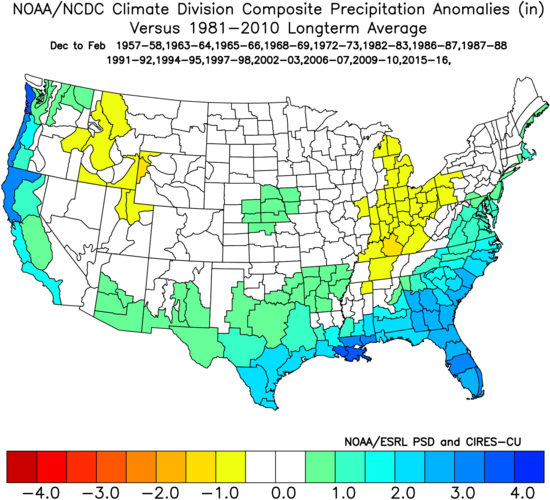
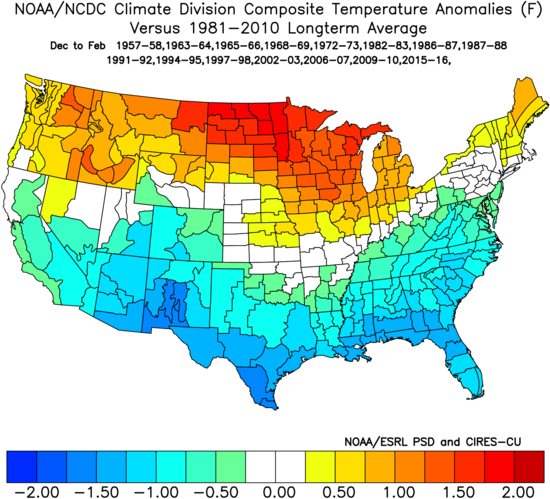
The strong correlation between El Niño and winter in this climate is with temperature, not precipitation: El Niño winters tend to be milder than average. So it is safe to bet that we are in for a milder than normal winter.

The correlation between El Niño and winter precipitation in this climate is not nearly so strong. Yes, our worst drought winters tend to be El Niño winters. No disagreement there. But that is the reverse of the correlation of interest: the correlation between A and B is not necessarily identical to the correlation between B and A.

In particular, the strongest El Niño events tend to be correlated with mild, wet winters in this region, not mild, dry ones. And the current El Niño is forecast to be exceptionally strong. Those drought winters? They tend to be correlated with normal to weak El Niño events, not the strongest ones.

Don’t take my word for it, here are the NOAA National Climate Data Center maps of temperature and precipitation anomalies of moderate-to-strong El Niño winters:

Source here.

It is likely that these milder than average conditions will result in higher than average snow levels, and thus a subpar ski season and a subpar snowpack in general. But that is a different thing from drought-level subpar snowpack. Other strong El Niño winters have generally not been drought winters, therefore I do not expect the coming winter to be one.

Finally, this does not mean no cold, snowy spells this winter.

First, the correlation between El Niño and winter conditions tends to be strongest in the latter part of the winter, after approximately New Year’s Day. It is not unusual for an El Niño winter to start with some early cold snaps.

Second, the correlation is between El Niño and milder average temperatures. It is entirely possible for there to be outlier events contrary to the general trend that determines an average; an overall warmer-than-average season can easily still feature a brief cold, snowy spell or two.

Third, our winters usually feature at least one cold, snowy spell in the lowlands. Snow-free, or nearly snow-free, winters like the past one are decidedly unusual. Even our mild winters usually feature at least some lowland snow.

So, to sum it up: Expect a milder-than-normal winter, but also expect some lowland snow. Do not expect a good ski season, but also do not expect a drought winter.