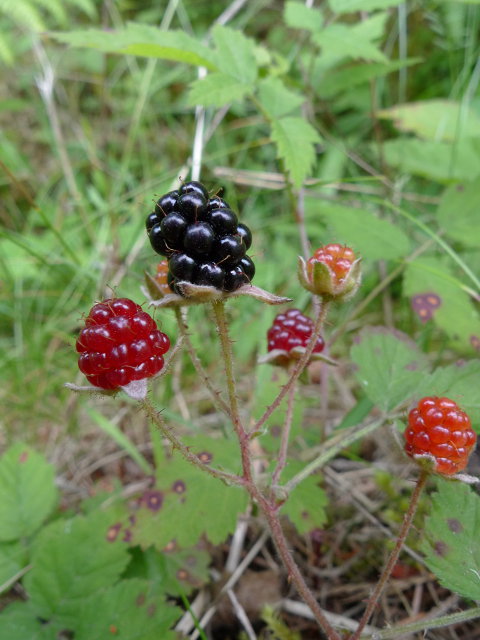
Peat Bogs: A Bit of Tundra in Our Backyard

Published at 11:17 on 24 May 2018

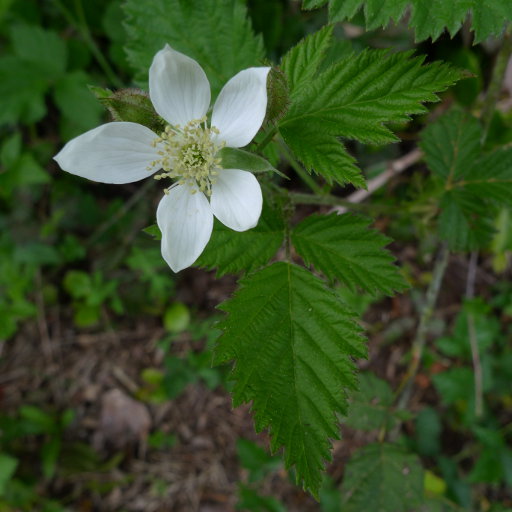
I’ve been out of town a fair bit recently, so this is a photo that was neither taken on Bainbridge Island nor even does it show a plant that grows here, for the plant depicted above is the Cloudberry, Rubus chamaemorus.

Seeing this flower for the first time was a highlight of my recent trip to BC. The one in the picture is one of the southernmost wild-growing Cloudberry plants in the world, as this plant’s range stops at the bogs of the Fraser River Delta, just north of the 49th parallel. It’s mostly a plant of the arctic tundra, but some populations do wander well south of the arctic in bogs.

Burns Bog has long been a forgotten and neglected part of the Vancouver metro area. There’s now efforts to preserve the parts of it that haven’t been drained and converted to other uses, but facilities for visitors are still very limited and not easy to find. Those interested in visiting a part of it that’s open to the public on their next trip to Vancouver can find the driving directions here.

Why do we see plants of the arctic tundra in peat bogs? It turns out that bogs mimic many of the soil conditions that form in the arctic. Like the arctic tundra, whose soil is prevented from draining by permafrost, bogs contain highly acidic waterlogged soil.

Why is Cloudberry found in these bogs, but not in ones just slightly further south, which have almost identical soil and environmental conditions? My best theory so far is that it has to do with migrating birds: before it was urbanized, the Fraser Delta was a huge complex of freshwater and tidal wetlands that served as a major wintering area for waterfowl, and at least one bird over the millennia arrived with a Cloudberry seed riding somewhere on it or inside its gut. Smaller peat bogs to the south failed to serve as major attractors of wintering waterfowl and thus never had this plant introduced to them.

The bog at IslandWood here on the island has no Cloudberry, but it does have a lot of Labrador Tea (Ledum groenlandicum), a plant whose common name references one northerly region and whose scientific one references another (Greenland), thus revealing its status as an arctic tundra plant.

Gmail Gets Suckier

Published at 10:41 on 18 May 2018

It’s always sucked because Google profiles you based on your emails, but Gmail gets suckier and suckier as time passes due to their security measures. Every time I do something the least bit unusual (like connect from a new wireless network) it blocks my IMAP logins and raises a security alert.

Wednesday, Gmail locked me out because I was coming in via the UW network as a guest there. Today, I’m on the road, and Gmail is locking me out because I’m using my old iPad plus my Karma hotspot to access it instead of my laptop and the very same Karma hotspot.

I can re-establish access by logging in via the Web, but:

  1. That totally defeats the purpose of my having an email client and using IMAP in the first place. I happen to like the fact that IMAP lets me use the same email client (with the exact same user interface) for all my email accounts.
  2. IMAP also uses less Internet resources than an interactive web site, which can be a plus in marginal situations (which do routinely happen when connecting to the Internet via a cellular network).
  3. If their web site lets me in, then IMAP should logically let me in as well.
  4. None of my other email providers have fascistic security like this.

I suppose Google hates the fact that using IMAP, because it implies I’m using a dedicated email client, which lets me freely choose email providers yet have the same consistent UI for each. Google apparently wants me to use their Web UI and get used to it, so I’m locked in to their service. In my book, that’s yet another reason to dislike Google.

As it is, I’ve been slowly moving to using my Apple me.com account for most of my mail, anyhow (because I don’t like how Google profiles me). Most of what goes to my Gmail inbox is from mailing lists that I simply haven’t bothered to cut over yet.

I guess it all shows that it’s time to continue with the gradual process of moving away from Gmail.

Goodbye for a Few Days

Published at 06:48 on 18 May 2018

I’m going to be out of town and away from the Internet until early next week. I hope to continue my recent habit of posting regularly here when I resume.

Vanilla Leaf

Published at 19:25 on 17 May 2018

Vanilla Leaf (Achlys triphylla) is now in full bloom. This distinctive forest-floor plant has leaves with three leaflets that arise directly from underground stems. Its tiny, white flowers arise in dense spikes from those same underground stems.

As its name implies, the leaves of this plant have a faint scent vaguely resembling vanilla. The odor becomes stronger if you gather a bunch of leaves and let them hang upside down to dry. In fact, I personally am not able to discern any vanilla odor from this plant unless its leaves are dried. For many years, it was a mystery to me why this plant has the common name it does.

Bundles of such dried leaves can be hung near doors and windows as an insect repellent; they have been used as such since pre-contact days by Native Americans. I have not personally tried it yet, but it is also reported that rubbing the fresh leaves on exposed skin can also act as an insect repellent.

You may be surprised to learn that this plant is a close relative the Oregon-Grape (Mahonia spp.). Both are in the barbarry family, Berberidaceae.

Ring V.2.0

Published at 11:47 on 17 May 2018

This is the eventual result of my having melted down scrap silver on the carbon block (see most recent post). That, plus a lot of forging and a fair bit of finishing.

Nice to have one that’s no longer overly thin and which is of fairly uniform thickness, because this time I didn’t run out of material (I had more scrap to work with).

Coat Charcoal Blocks with Boric Acid to Prevent Burning

Published at 20:09 on 16 May 2018

I bought a charcoal block to do some fusing of sterling silver on.

I’ve tried fusing metals on the firebrick that I normally use as a heat-resistant surface when soldering and annealing, and have found that sometimes the molten metal flows into the interstices between the grains in the brick and then, when solid, sticks to it. The result is virtually impossible to remove without some bits of firebrick material embedded in it. Moreover, the firebrick itself has acquired an undesired divot in its surface.

The charcoal block avoids that problem neatly, but it has a problem of its own: being charcoal, it catches fire. Even if I put the glowing/burning bits out with a wet finger, some of the surface has already combusted into carbon dioxide and literally vanished into thin air. A charcoal block’s surface thus quickly becomes unusably irregular.

Yesterday the idea came to me to coat one of the remaining good surfaces of my charcoal block with boric acid barrier flux and to set it alight. My theory was that since borates are used in fire retardants (and I believe in the antiafterglow compound that matches are treated with), the boric acid which would be deposited by doing the above was likely to prevent the carbon from catching fire.

It does! Plus, the porous surface of the charcoal absorbed a significant amount of flux, so the whole thing burned very prettily with a large green flame that lasted about a minute and put on quite the show.

Why Does Taleo Even Fucking Exist?

Published at 18:16 on 15 May 2018

It’s so-called “talent management software” that many HR departments use. It’s also a piece of total garbage. Typical Taleo experience:

  1. Follow a link from Indeed to the Employer’s site, which uses Taleo.
  2. Be blocked from going further because you must log on.
  3. If you don’t have an account, you must register, and when you do that, Taleo “forgets” the job that brought you there. You must go back to the linking site and follow the link again.
  4. If you do have an account, it still doesn’t matter. Taleo will virtually always claim the job doesn’t exist anymore after you log on. Again, you must go back to the linking site and follow the link again.
  5. You will then be prompted to enter, by hand, basically your entire résumé. You cannot just cut and paste it in one fell swoop, because Taleo is coded to break everything into zillions of fields (employer, address, phone, dates worked, etc.).
  6. You will then be asked to upload your résumé.
  7. Odds are, you will never receive a call back, because you failed to include some obscure keyword that Taleo was insisting be there for the job in question.
  8. None of the work you did will matter for any other employer that uses Taleo, as there is no information sharing happening. You will have to key in your entire résumé by hand again.

Regarding forcing users to register, why the fuck do that? Isn’t the goal of advertising anything (be it a job vacancy or pork chops at the supermarket) to attract people? Forcing applicants to register just says “go away, we’re really not that serious about filling this position.”

Regarding uploading a résumé, this is a completely reasonable thing to ask. Thing is, most every other job application system out there can parse a résumé (there’s stock libraries for doing this; it’s a solved problem). Only Taleo forces you to key in the thing from scratch, anew. Again, this basically amounts to a “go away, we’re really not that interested” sign on a virtual door.

How unreasonable Taleo is may be underscored by comparing it to the experience of applying to a job in the pre-Internet days: You’d compose a cover letter, and stuff that along with your résumé (copied on a copier, not typed anew for each employer) in an envelope, put a stamp on it, and drop it in a mailbox.

Taleo may also be shown to be unreasonable by comparing it to Indeed.com, which lets employers manage applications (if they pay Indeed for that service). You get asked for your contact information, get a box in which to compose a cover letter, and get asked to upload your résumé. A complete analogue of what you did in the snail-mail days (absent paying postage and sometimes waiting most of a week for delivery to complete); simple and totally reasonable.

Or compare Taleo to competitors like Jobvite, which prompt you for your résumé first, then parse it and populate the form fields automatically, allowing you to correct any mistakes the parser made. A little more work, but still pretty reasonable, even if it does go through the unnecessary step of forcing you to register and log in.

The mystery, to repeat, is why this piece of absolute garbage even exists. It’s got to be crap for the HR people to use, as well (software is very seldom crap in just one area; if one part of a package is crap, the crap quality typically extends package-wide). There’s so many better options already out there.

If market forces worked like capitalism fans theorize they did, Taleo would have been compelled by such forces to fix their garbage software or would have gone out of business years ago. Yet Taleo remains, one of those counterexamples to the assertion that markets inevitably foster excellence.

The Embassy Move is Not a Favor for Israel

Published at 08:29 on 14 May 2018

It is a favor for domestic Christian fundamentalists (a core part of Trump’s base), who believe that:

  • The Old Testament of the Bible is a title deed that allows the Zionists to occupy and claim land by force, and
  • Israel needs to occupy that land (all of it, from the river to the sea) in order to fulfill the prophecies in the New Testament’s Book of Revelation.

That it is a favor for Christian fundamentalists (and not Zionists) perfectly explains why this pastor was invited to speak at the embassy’s opening.