It’s as stupid for the GOP to demolish protections for the minority in the Senate as it was for the Democrats to do it 2013. Really, guys, you actually think your Senate majority will be permanent? When has that ever been the case? Trust me: payback’s gonna be a real bitch.
I was going to make a long post of my own about it, but Vox just preempted me. Executive summary (I encourage you to read the Vox article):
Boeing found themselves painted into a corner by decades-old design decisions whose consequences they couldn’t have foreseen.
Basically, it was not possible to easily and quickly make a safe aircraft that was more fuel efficient, to compete with the new Airbus A320neo.
Boeing should have sucked it up and taken the loss involved in playing catch-up with Airbus.
Instead, they decided to bolt new, more efficient engines on the existing 737 airframe (even though they didn’t really fit) and christen the result the 737 Max.
The new planes had kludges installed (sensors and software) in an attempt to paper over their fundamental unairworthiness.
A corrupt relationship with the FAA allowed the kludged-up planes to be approved and sold.
The inevitable happens.
Really, it should come as a surprise to absolutely nobody that a plane that substitutes good engineering practices based on the laws of physics operating in the real world, for software operating in cyberspace, ends up sometimes startling and surprising pilots, sometimes with tragic results. It should also come as no surprise that said software has bugs, also sometimes with tragic results.
The most important overall rule of software development is that it’s extremely difficult to get right. As someone who’s worked in that field, I know this by first-hand experience.
In a recent New York Daily News opinion piece, Rick Wilson claims:
That’s why the Democrats have two options for the 2020 presidental race: Make the race a referendum on Trump and Trumpism, or lose.
No. No those are not the two choices the Democrats face. This is not even remotely true.
The Democrats already have had an election where they campaigned as a referendum on Trump and Trumpism: the 2016 presidential election. That was most of Hillary Clinton’s platform: being the Not Trump candidate. And we all know how well that worked out.
Moreover, opposition parties facing authoritarian movements have generally failed when they campaign on the “at least we’re not them” platform. It’s what doomed the opposition for decades in Venezuela and Italy. They campaigned on being Not Chávez and Not Berlusconi in multiple elections… and lost every one.
It was only when the opposition changed their campaign tactic to “what we can do better for you” that their fortunes changed.
Ignore the Not Trump line. Everyone interested in voting Trump out already knows that means voting for the Democrats in 2020. The Democrats have an absolute lock on the Not Trump vote; as such, any additional effort focused on this sales tactic is wasted.
Look, I get it: Rick is a conservative. For him, personally, about the only thing good about the Democrats is that they are Not Trump. He’s not enthused about any of their other policies. He’s not looking forward to holding his nose and voting for a Democrat. But hold his nose and vote Democrat he will.
One of the greatest errors in thinking one can make is to extrapolate one’s own beliefs onto others. For millions of Americans, Trump is not so abjectly repugnant as he is to Wilson (or, for that matter, yours truly). Yes, it would be a great thing if he was: Trump would have never been elected. But wishing something were so does not make it so.
I still remember the first time I discovered this ant, decades ago in a subalpine meadow in Colorado. I stepped on what I thought was an odd patch of dried bits of last year’s meadow grass. My foot sank into it and my leg was instantly covered in angry ants! Fortunately, I managed to brush them off before I received many bites.
I was astounded by how large that anthill was. Little did I know at the time that that particular colony was only a small-to-medium-sized one as this ant goes. After I moved to the Pacific Northwest, I started regularly encountering colonies of this ant. One I spied in the Cascades of Oregon was five feet high and a dozen feet in diameter!
The anthill pictured below is a fairly average size for this species’ colonies (note my bicycle helmet for scale). As always for this species, it is constructed of plant debris, not soil or sand. This anthill is near a road and I first noticed it when riding my bicycle past it.
Formica obscuripes colony.
It was teeming with activity; every square inch of it contained at least several ants.
Formica obscuripes.
These ants have an undeserved reputation for being aggressive biters. Bite they do, and after their mandibles break the skin they add insult to injury by spraying formic acid into the wound, causing further irritation and pain. But unless one is one of the few unfortunates who is abnormally sensitive to formic acid, the bite is minor and the pain quickly vanishes.
Moreover, in my experience these ants tend to be reluctant to bite. I spent ten to fifteen minutes acquiring the photographs in this article, and received but a single bite for my efforts, despite being in the immediate proximity of a hill teeming with thousands of ants and even accidentally bumping that hill and doing minor damage to it with a leg of my tripod.
Formica is the Latin word for “ant,” and this genus is the type genus for entire ant family, Formicidae. The plastic used for kitchen countertops that goes by the same name has nothing to do with ants, being so named because it was originally envisioned as being a substitute material for mica. Formica is, however, how formic acid (first discovered in ants) and chemically similar compounds like formaldehyde got their names.
These ants have quite a profound impact on the plants in the areas they inhabit. This is one of the ant species that tends and spreads aphids, feeding off the honeydew that the aphids secrete. They also dislike plants in the immediate neighborhood of their colonies, and will chew through the bark and spray formic acid on the resulting wounds, which eventually kills the attacked plants.
Their impact on the plant world is far from entirely baleful, however: many of our woodland wildflowers, such as trilliums and bleeding hearts, are dispersed by ants. Their seeds bear oily, nutrient-rich bodies called elaiosomes whose purpose is to attract ants, which usually carry the seeds for some distance before removing the elaiosome and discarding the rest of the seed.
These ants are plentiful here on Bainbridge Island, and our woods are full of blooming trilliums in the spring. I have never seen these ants inside the city limits of Seattle, and even in Seattle’s larger wooded parks, trilliums are an unusual sight. I do not believe these facts to be mere coincidence.
* No knowing, orchestrated collusion by the Trump campaign, that could plausibly be demonstrated beyond a reasonable doubt to a judge and a jury, that is.
There is, however, a big puzzle piece that simply doesn’t fit right: why did Mueller catch so many people in and closely connected to the campaign lying about their connections to Russia? It doesn’t make sense: why like to an investigation (exposing yourself to being prosecuted for perjury), if you have committed no crime?
There are a number of plausible explanations, some that are fairly innocent, some otherwise. (In the latter category, what if Mueller almost found enough to prosecute the campaign for illegally colluding, but not quite?) Absent as full as possible a release of the report, we will never have any idea how to explain this discrepancy. It is for this very reason that a full release is desirable.
Beyond that, all of us in the anti-Trump crowd should put a lid on the whining. The whole reason for investigating was that we didn’t know enough and thought that there probably, but not definitely was serious dirt to be found. Mueller didn’t find the expected dirt, most likely because that dirt simply doesn’t exist. Sometimes, gut feelings end up being wrong. Deal with it.
This is, after all, why societies that worry about becoming repressive don’t automatically punish wrong-doers on mere suspicion, but instead require evidence, evidence that must typically be uncovered via investigation. An investigation is not a conviction.
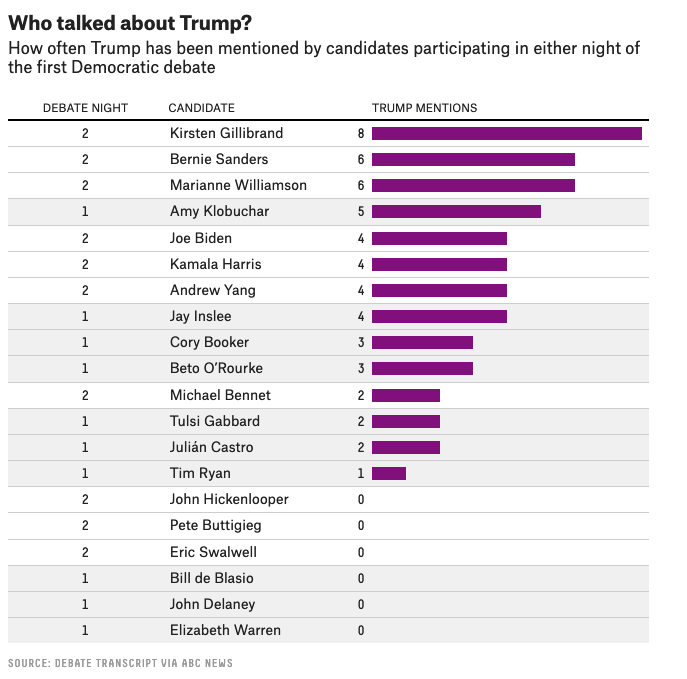
On top of all that, there are many other reasons for which Trump should be opposed, and many of those reasons are more likely to be fruitful and convincing campaign material. Trump’s personal faults, as bad as they are, have never ranked terribly highly. Consider this poll, for example.
One of the reasons the opposition failed to unseat Berlusconi for so long in Italy was that they were too preoccupied with Berlusconi himself, instead of the conditions that had prompted many to vote for him. So can the “Russia, Russia, Russia” crap and move on to more fruitful avenues of criticism.
Normally these boom in late February, but we did not have a normal February. This one was in a wet ditch by a road, so its young shoots probably spent much of last month smothered in dirty, compacted snow pushed there by the plows. Aside from being delayed in blooming, little harm seems evident to them.
Exhibit B is how the Trump Regime deferred to Boeing, grounding the troubled 737 Max series of jets days after even third-world backwaters without precisely stellar records of aviation safety did.
First, the Leave campaign cheated. They lied, and they peddled foreign influence. Cheaters in sports get stripped of any titles their cheating played a role in. Why shouldn’t cheaters in politics suffer a similar fate, particularly given how the consequences of their cheating can be vastly more severe?
Second, decisions shouldn’t always be irrevocable. We’ve all done things we regret, only to back out as best we can and admit we were wrong for making what hindsight showed to be a wrong decision in the first place. Sure, some decisions are intrinsically hard to undo, but why should that be used as an excuse for making all decisions artificially difficult to undo?
Hold another referendum. If it fails, try as hard as possible to shit-can the whole misadventure. In such a case, it’s likely the rest of the EU will go along with Britain’s wishes; the trade disruption caused by a Brexit would hurt the Continent, too.
It’s been a hard winter. You can see it in the patches of the Himalayan Blackberries, which were pressed flat by the heavy snows of early February (and which lost their leaves thanks to overnight lows in the teens):
In wooded areas where native vegetation prevails, the sword ferns were also affected:
“Hard winter” is of course a relative term; anyone from Chicago or Denver would laugh at the notion that a winter where for the vast majority of time it was above freezing with green lawns and a snow-free ground was “hard.” But for us, it’s unusual to have a spring where there are lingering signs of the snow we had even after it’s gone. I’ve only seen it a few times in the quarter-century I’ve lived in this ecoregion.
Yes, she did use the phrase “allegiance to a foreign country.”
Accusations of dual or conflicted loyalty have an ugly history behind them, to the point of being a standard trope in antisemitism.
Yes, the phrase was part of one sentence of a larger speech, the rest of which did not exhibit antisemitic rhetoric.
Point (3) is less relevant than it may seem. There’s a long history of political gaffes being ripped out of larger context and getting repeated over and over. This is hardly the first case. It’s a standard occupational hazard of being a politician.
There’s basically two options at play here, neither of which make Ms. Omar look particularly good:
She said what she said because it reflects her true inner biases; i.e., she’s a bigot.
She said what she said because she didn’t know better; i.e., she’s an ignoramus.
The Republicans have been far worse; just witness how little they did over the years as Steve King evolved into being an outright fascist.
The resolution that passed was a pretty good one. It acknowledged the generally bad record of bigotry in the House in recent years and condemned it in general, instead of simply singling out a possibly bigoted left liberal and being silent on all the other instances.
It proved a political masterstroke as well, because the Republicans, being a party of re-branded fascism, could not stomach the idea of condemning bigotry in general—and are now on record for it.
Might this all end up proving that being a somewhat bickersome “big tent” party is in the Democrats’ best interest? Consider that the resolution that was brought up and passed was nobody’s first choice: The left wing of the Democratic Party didn’t want any criticism of any one of their own, and the right wing wanted something that only went after this particular instance of bigotry. In the process of bickering and squabbling the Democrats came up with… a political masterstroke that neither faction would have come up with on their own.